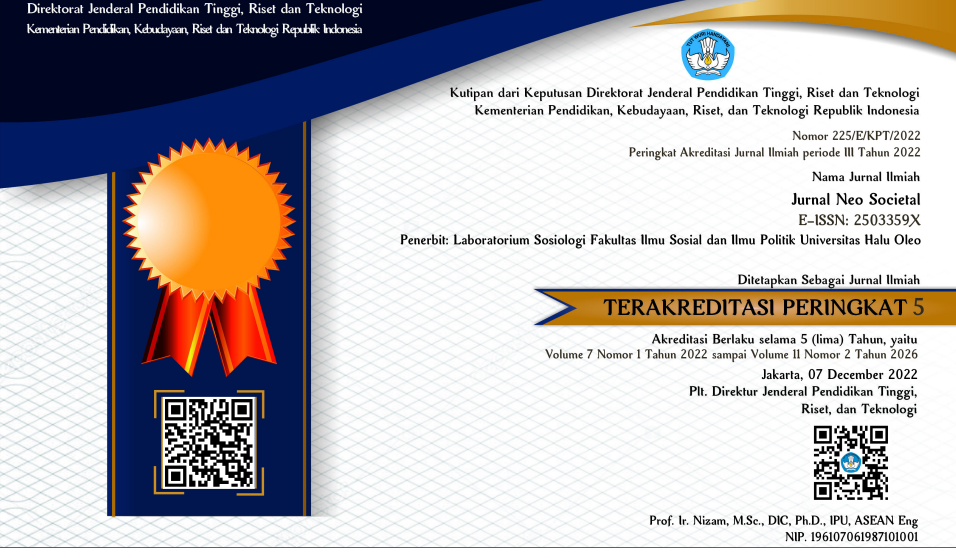
PERINGKAT SINTA

INFORMASI AUTHORS

AUTHORSHIP AND CONTRIBUTORSHIP
Journal Neo Societal (JNS) adopts the Contributor Roles Taxonomy (CRediT), following the ANSI/NISO Z39.104-2022 standard, to ensure transparency and accountability in authorship. All authors must specify their contributions using the 14 standardized CRediT roles, recognizing their respective involvement in sociological research, including research design, fieldwork, data collection, analysis, and manuscript preparation. This policy promotes fair attribution of scholarly contributions and responsible authorship practices.
At Journal Neo Societal (JNS), authorship is determined by significant intellectual contributions to sociological research and the development of scholarly manuscripts. All listed authors must demonstrate meaningful involvement in the research and take responsibility for their respective contributions.
To qualify for authorship, individuals are expected to:
Authorship must reflect genuine scholarly involvement rather than academic rank, institutional position, supervisory responsibility, administrative authority, financial support, or personal relationships.
Individuals whose involvement does not meet the authorship criteria should be recognized in the Acknowledgements section, where appropriate, rather than included as authors. Such recognition should accurately reflect their contributions while maintaining transparency and accountability in scholarly publishing.
Journal Neo Societal (JNS) implements the Contributor Roles Taxonomy (CRediT) in accordance with the ANSI/NISO Z39.104-2022 standard. This framework identifies 14 standardized contributor roles to ensure clear, consistent, and transparent recognition of individual contributions to scholarly publications.
JNS recognizes the following 14 CRediT roles:
|
No. |
CRediT Role |
Description |
|
1 |
Conceptualization |
Formulation of the central research ideas, objectives, research questions, and conceptual or theoretical foundations guiding the study. |
|
2 |
Data Curation |
Organization, documentation, annotation, cleaning, preservation, and management of research data, including interview transcripts, field notes, survey datasets, and other materials for present or future research use. |
|
3 |
Formal Analysis |
Application of quantitative, qualitative, statistical, computational, or other systematic analytical techniques to examine, interpret, or synthesize research data. |
|
4 |
Funding Acquisition |
Securing financial resources or research grants necessary to conduct the study or support the scholarly publication. |
|
5 |
Investigation |
Implementation of research activities, including fieldwork, interviews, observations, surveys, document analysis, evidence collection, or other relevant investigative procedures. |
|
6 |
Methodology |
Design, development, selection, and refinement of research methods, methodological procedures, analytical strategies, or research models. |
|
7 |
Project Administration |
Planning, organizing, managing, and coordinating research activities, schedules, documentation, and administrative responsibilities throughout the project. |
|
8 |
Resources |
Provision of research materials, datasets, instruments, archival sources, software, equipment, facilities, infrastructure, or other resources required for the study. |
|
9 |
Software |
Development, programming, implementation, modification, testing, or maintenance of software, algorithms, computational models, or coding tools used in research and data analysis. |
|
10 |
Supervision |
Academic oversight, research leadership, mentorship, and supervision of research activities, processes, or team members. |
|
11 |
Validation |
Verification and assessment of the accuracy, reliability, consistency, reproducibility, or trustworthiness of research methods, analytical procedures, findings, and other research outputs. |
|
12 |
Visualization |
Development and presentation of visual research materials, including tables, charts, figures, diagrams, conceptual models, maps, or other graphical representations of research findings. |
|
13 |
Writing – Original Draft |
Preparation and writing of the initial manuscript, including the development of its substantive sections and presentation of research arguments and findings. |
|
14 |
Writing – Review & Editing |
Critical examination, substantive revision, editing, commentary, and refinement of the manuscript during its preparation and publication process. |
These roles follow the internationally recognized CRediT taxonomy established by NISO. Individual contributors may undertake more than one role, and the same role may be shared by several contributors where applicable. Authors are not required to fulfill all 14 roles, but their declared contributions must accurately reflect their actual involvement in the research and publication process.
All manuscripts submitted to Journal Neo Societal (JNS) are required to provide a CRediT statement specifying the individual contributions of each author.
The statement must accurately describe each author's actual involvement in the research and manuscript preparation and must be reviewed and approved by all authors before submission.
The CRediT statement may follow the format below:
Author Contributions:
Author 1: Conceptualization, Methodology, Software, Formal Analysis, Writing – Original Draft.
Author 2: Data Curation, Investigation, Validation, Visualization, Writing – Review & Editing.
Author 3: Supervision, Project Administration, Funding Acquisition, Writing – Review & Editing.
Authors should only declare CRediT roles that genuinely correspond to their contributions to the research.
As research activities often involve overlapping responsibilities, a single author may be credited with several CRediT roles. Similarly, multiple authors may share responsibility for the same role.
The CRediT statement serves to clearly document how scholarly responsibilities and contributions are distributed among authors, rather than to establish an authorship hierarchy based on the number or perceived significance of assigned roles.
The Contributor Roles Taxonomy (CRediT) provides a standardized framework for reporting research contributions and strengthening transparency. It does not independently determine whether an individual qualifies for authorship.
The Corresponding Author acts as the principal liaison between the authors and the editorial office of Journal Neo Societal (JNS) throughout the manuscript submission, peer review, revision, production, and publication stages.
The Corresponding Author is responsible for:
The designation of Corresponding Author reflects responsibility for editorial communication and coordination and does not necessarily imply that the individual has made the most substantial intellectual or scholarly contribution to the research.
Following manuscript acceptance or publication, changes to authorship information will generally not be permitted, except where corrections are necessary to address verified errors or publication ethics concerns, subject to editorial assessment and applicable ethical guidelines.
Journal Neo Societal (JNS) acknowledges that disagreements concerning authorship and individual research contributions may emerge at different stages of the research, manuscript submission, editorial evaluation, or publication process.
JNS maintains that authorship must reflect genuine intellectual and scholarly contributions rather than academic titles, institutional affiliations, seniority, supervisory roles, administrative authority, or financial support.
In cases of authorship disputes, the journal may require the parties involved to pursue resolution through their respective academic institutions or organizations responsible for conducting or overseeing the research.
The JNS editorial office may assist in facilitating communication between the parties concerned. Nevertheless, the journal will not independently assign or revoke authorship without sufficient supporting evidence or appropriate institutional verification.
When addressing authorship disputes or related allegations, JNS refers to the relevant principles and procedures established by the Committee on Publication Ethics (COPE), ensuring that such matters are handled fairly, transparently, and in accordance with established standards of publication ethics.
Journal Neo Societal (JNS) upholds responsible authorship practices by ensuring that scholarly contributions are accurately acknowledged and represented. The journal prohibits authorship arrangements that misrepresent an individual's actual involvement in research or manuscript preparation.
Ghost Authorship, occurs when an individual who has made a substantial intellectual or scholarly contribution to a research project or manuscript is excluded from the author list without appropriate recognition. Individuals whose contributions fulfill the journal's authorship criteria must be properly acknowledged as authors. Their involvement in the research or preparation of the manuscript must not be deliberately concealed or omitted.
Guest Authorship, involves listing an individual as an author despite their lack of meaningful intellectual or scholarly contributions to the research or manuscript. Authorship must not be granted merely on the basis of academic status, professional reputation, institutional authority, or personal or professional relationships with other authors.
Gift Authorship, refers to assigning authorship as a gesture of courtesy, personal favor, professional reward, or perceived obligation without a corresponding substantive contribution to the scholarly work. Authorship recognition must be based on legitimate intellectual involvement rather than personal considerations, institutional expectations, or professional reciprocity.
Journal Neo Societal (JNS) regards ghost authorship, guest authorship, and gift authorship as violations of responsible authorship practices that undermine research integrity, transparency, and established principles of publication ethics.
Journal Neo Societal (JNS) allows authors to recognize individuals or institutions that have supported the research or manuscript preparation but whose contributions do not fulfill the journal's authorship criteria. Such contributions may be appropriately acknowledged in the Acknowledgements section.
Acknowledgements may include, but are not limited to:
Where applicable, authors should inform individuals and obtain their consent before identifying them by name in the Acknowledgements section.
Acknowledgements must not serve as a substitute for legitimate authorship. Individuals whose intellectual or scholarly contributions satisfy JNS's authorship criteria must be appropriately recognized as authors rather than acknowledged solely as supporting contributors.
Journal Neo Societal (JNS) recognizes the accurate identification and acknowledgment of authorship and individual scholarly contributions as essential principles of research integrity, academic accountability, and ethical scholarly publishing.
To uphold these principles, all authors are required to:
Any false, misleading, or deliberately incomplete declaration of authorship or individual contributions may be regarded as a breach of JNS's publication ethics policy and may lead to appropriate editorial measures in accordance with the journal's established procedures and relevant publication ethics principles.
Journal Neo Societal (JNS) implements the Contributor Roles Taxonomy (CRediT) in accordance with ANSI/NISO Z39.104-2022 as a standardized framework for ensuring transparency and consistency in the disclosure of individual contributions to scholarly publications.
JNS recognizes all 14 standardized CRediT contributor roles and requires authors to accurately declare their respective involvement in the research and preparation of submitted manuscripts.
The journal applies CRediT as a framework for contributorship transparency and accountability, rather than as a substitute for established authorship criteria. The assignment of CRediT roles does not, by itself, determine an individual's eligibility for authorship.
Through this policy, JNS aims to promote transparency, academic accountability, research integrity, and equitable recognition of scholarly contributions across sociology and related social sciences, particularly in research addressing social structures, social relations, cultural practices, religious life, social institutions, inequality, identity, and processes of social transformation.